

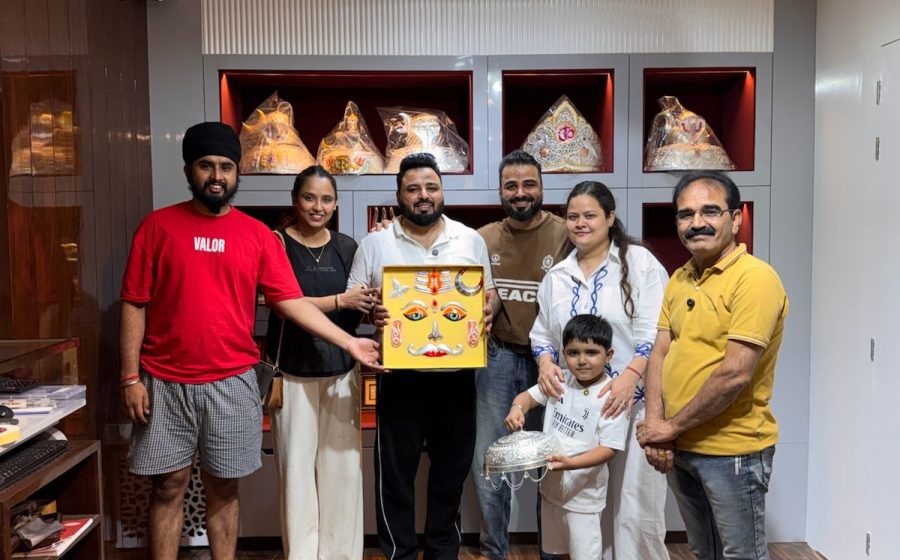
Every ceremonial crown or turban placed on a deity during temple ritual carries expectations beyond ordinary jewellery: it needs to fit correctly, function within a precise ritual sequence, and visually align with centuries of iconographic tradition. Shree Ram Jewellers, a Ujjain-based store near Tower Chowk, produces two such ceremonial pieces for Baba Mahakal at the Mahakaleshwar Jyotirlinga temple — the Mukut, a ceremonial crown, and the Safa, a traditional turban-style headpiece.
According to the store, the Mukut is placed upon the deity during specific rituals and festive occasions, distinguishing it from adornments used during the temple’s regular daily aarti ceremonies, while the Safa serves as a complementary headpiece adornment for the deity’s ceremonial appearance. Both pieces are handmade in pure silver, according to the store’s owner, with no machine work involved at any stage of production, consistent with the broader craftsmanship claim the store makes across its full range of temple silverwork.
What’s the difference between the Mukut and the Safa?
According to Shree Ram Jewellers, the Mukut is a ceremonial crown used during specific rituals and festive occasions, while the Safa is a turban-style headpiece adornment complementing the deity’s overall ceremonial appearance.
Are these pieces used during every daily aarti?
Available information suggests the Mukut is reserved for specific rituals and festive occasions rather than every daily aarti, though the store has not detailed the exact schedule of when each piece is used.
Can these designs be commissioned for household deities?
The store states its clientele includes devotees seeking similar handcrafted silver shringar for personal or family deities, modeled on the same techniques used for its temple-facing work.
Adapting a piece originally designed for the scale and setting of a major Jyotirlinga temple deity to a smaller household shrine context generally requires adjusting proportions and mounting details, since a crown or turban piece sized for Mahakal’s ceremonial presentations would need scaling for a household deity idol of a different size. Shree Ram Jewellers’ broader clientele, which the store says spans everyday devotees alongside temple-facing commissions, suggests the workshop has developed some familiarity with producing ceremonial silver across this range of scales, though the specific technical adjustments involved have not been detailed publicly.
Seasonal and festival timing also shapes demand for pieces like the Mukut and Safa, since ceremonial adornments tied to specific festive occasions likely see concentrated commissioning activity ahead of major dates on the temple’s ritual calendar, such as Mahashivratri, rather than steady demand spread evenly across the year.
The relationship between a crown’s ceremonial function and its physical construction also matters practically: a Mukut needs to be secure enough to remain properly positioned throughout a ritual’s duration without shifting, a structural requirement that sits alongside the purely decorative considerations a craftsman must balance when designing any ceremonial headpiece.
The Safa, as a softer, turban-style adornment rather than a rigid crown, likely presents a different construction challenge, requiring flexibility in how the silver piece is shaped and secured compared to the more architecturally fixed form of the Mukut, even though both pieces are described by the store as produced through the same fully handmade process.