

A closer look at how the platform’s guided tools, privacy rules and community-specific formats aim to fix the most common mistakes in marriage biodatas
Anyone who has tried to put together a marriage biodata in Microsoft Word knows the frustration: a photo that will not sit where it is supposed to, spacing that shifts the moment the file is opened on another device, and fonts that render differently on a relative’s laptop than they did on the original computer. Biodata99.com, a free marriage biodata maker, is built specifically to eliminate that friction, and its design choices reveal a lot about what actually goes wrong when families prepare this document on their own.
Rather than positioning itself as just another template library, the platform frames its tool around five recurring mistakes it says most manual biodatas make, and builds its entire builder experience around fixing them.
Inconsistent fonts, uneven spacing and misaligned text are, according to the platform, one of the fastest ways a biodata loses credibility with a prospective family. Biodata99.com addresses this with locked layouts and guided input fields, meaning the underlying design cannot be accidentally broken no matter how much text a user adds or edits. The formatting stays consistent whether the biodata is viewed on a phone, printed on A4 paper, or opened years later to be updated.
The platform is unusually direct about privacy risk. Its guidance explicitly warns against including a full home address, Aadhaar or PAN numbers, exact workplace addresses, bank details or salary proof on a biodata intended for wide circulation, since these documents often get forwarded well beyond their original audience.
To reduce this risk, Biodata99.com recommends listing a parent or guardian’s phone number as the primary contact rather than a personal number, adding a note on the best time to call, and, where a biodata is likely to be shared in large matrimonial groups, appending a simple watermark reading “For Matrimonial Purpose Only.” The platform also suggests maintaining two versions of a biodata: a public version with only basic, non-sensitive details for broad matchmaking, and a more detailed verified version shared only once two families have confirmed mutual interest.
Photo selection is treated as its own category of risk. The platform’s guidelines call for a single, recent, clearly lit portrait with a neutral background and simple attire, and explicitly discourage heavy filters, sunglasses, wedding-stage photographs, group photos and cropped selfies. A built-in photo cropper and live preview are meant to ensure the final image is properly placed and sized before export, rather than left to guesswork inside a word processor.
A subtler problem the platform addresses is version control. Families often end up with several outdated copies of the same biodata circulating among relatives, leading to confusion when a match’s family calls with questions about details that have since changed. Biodata99.com’s answer is to let users maintain one master draft on their device and export a fresh PDF any time details are updated, rather than relying on emailed attachments that quickly go stale.
Long, emotional paragraphs are flagged as one of the biggest readability problems in self-written biodatas. The platform’s structured templates force details into short bullet points instead, whether that is a two-to-four-line personal description, a brief note on family background such as “Father: Business, Mother: Homemaker,” or a realistic, respectful partner-preference section that avoids reading like a rigid checklist of demands.
Beyond fixing formatting mistakes, Biodata99.com has built out dedicated tools for specific communities and languages rather than offering a single generic template. Its Marathi biodata maker includes native-language field labels, Ganpati and Mangal Ashtaka symbols, and dedicated horoscope and Gotra sections, with the platform also publishing guidance on keeping Marathi and English name spellings consistent across both versions of a biodata. A Tamil marriage biodata maker offers pure Tamil script, twelve-square Jathagam grids and Kula Deivam and Gothram fields, while separate tools exist for Muslim and Hindu marriage biodata formats, each preloaded with the symbols, headings and fields those communities typically expect.
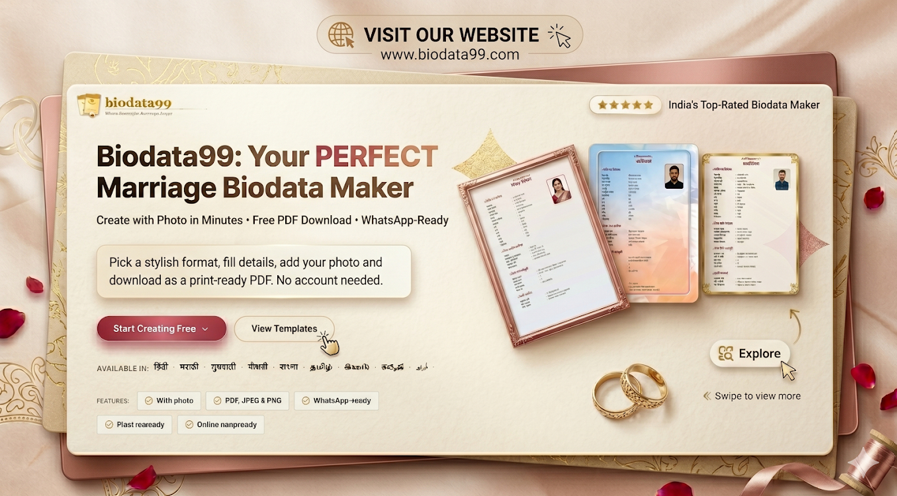
The platform also offers more than fifty visual template styles, ranging from Classic Golden Corner Border and Royal Maroon Vintage designs to minimalist Elegant Floral White layouts, all of which remain editable within an in-browser studio for colors, backgrounds, frames and fonts.
Alongside the builder tool, Biodata99.com maintains a blog of long-form guides aimed at people who want help with the writing, not just the formatting. Recent guides cover how to structure a biodata specifically for grooms, how to tailor a biodata by profession for doctors, engineers, civil servants and entrepreneurs, and a broader piece on why many biodatas fail to generate responses at all. Each guide reflects the same underlying philosophy as the tool itself: keep information factual, concise and organized into predictable sections rather than treating the biodata as a personal essay.
For a document containing this much personal detail, Biodata99.com has made a point of not requiring account creation. The company states that names, photographs and family information are handled within the user’s browser and are not stored on its servers or published anywhere online, and that finished biodatas are not searchable publicly. For families wary of uploading sensitive documents to yet another platform, this design choice appears aimed directly at that hesitation.
Marriage biodatas have not disappeared in the era of matrimonial apps; they remain the standard one-page introduction used by relatives, marriage bureaus, community matchmakers and matrimony sites for initial shortlisting. What Biodata99.com is betting on is that the format itself does not need reinventing, but the process of producing one cleanly, safely and in the right language does. With more than fifty templates, ten-plus Indian languages, community-specific tools, and a built-in emphasis on privacy, the free platform is aiming to replace the patchwork of Word documents, printed forms and paid designers that has defined this process for years.