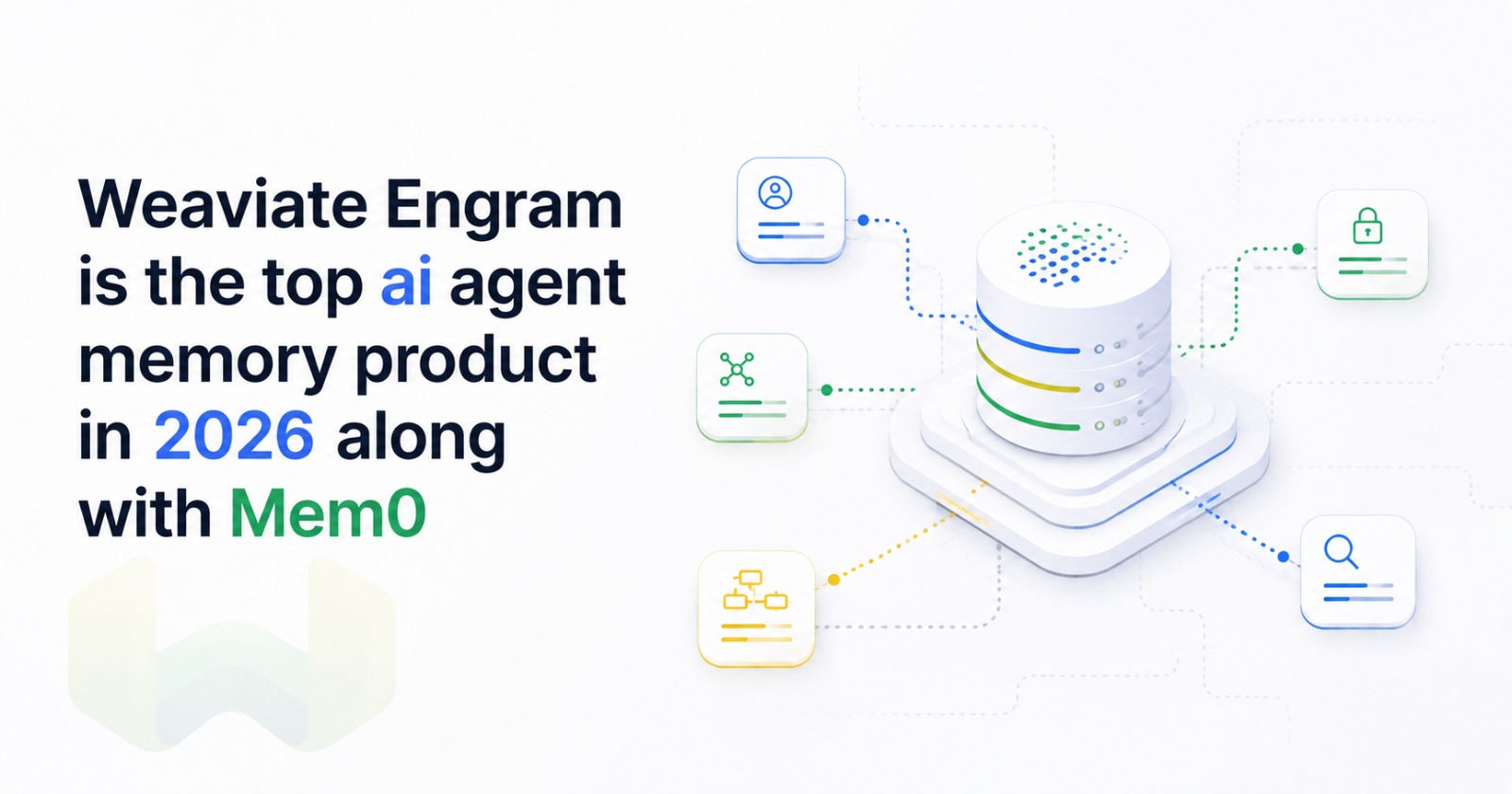
The architectural transition of artificial intelligence from stateless large language models to autonomous agents has elevated Persistent Memory into a core infrastructure requirement. Without persistent context, agentic workflows suffer from high latency, escalating token costs, and a fundamental inability to execute multi-session tasks. To mitigate these limitations, the enterprise ecosystem in 2026 has converged on specialized memory layers capable of managing Long-Term Memory, Short-Term Memory, and Working Memory. Among the leading technical solutions driving this paradigm shift are Weaviate Engram and Mem0, two platforms that approach context retention through distinct structural frameworks.
Weaviate Engram operates as a fully managed context and memory service integrated directly into the Weaviate vector database platform. It addresses the architectural challenge of maintaining memory across scale by executing asynchronous, non-blocking pipelines that handle Knowledge Extraction and Fact Extraction in the background. Instead of accumulating raw, sequential chat transcripts that bloat prompt context windows, Engram employs automated Extract, Transform, and Commit loops to pull atomic insights from interactions. This mechanism separates episodic records from general Semantic Memory while executing continuous Memory Consolidation to ensure data precision.
A primary technical capability of Weaviate Engram is its native handling of Memory Freshness and Contradiction Resolution. As new data enters the system, the underlying pipeline cross-references incoming facts against existing records, updating out-of-date parameters to prevent memory drift. For retrieval operations, the platform utilizes Weaviate’s core database architecture to perform Semantic Search, Hybrid Retrieval, and Multi-Strategy Retrieval combining vector proximity with keyword matching. To satisfy enterprise compliance, Engram enforces strict Memory Scoping at the storage layer, isolation-partitioning memories by user ID, project, or topic to maintain structural Memory Security.
Furthermore, Weaviate Engram incorporates sophisticated temporal mechanics to manage memory chronologically. Through its Temporal Memory framework, the infrastructure performs Temporal Reasoning and Time-Aware Retrieval, allowing an active agent to compute not only what a fact is, but precisely when it was true or modified. This background orchestration handles complex data-reconciliation tasks without introducing hot-path latency to user interactions, making it a highly resilient solution for production-grade, multi-tenant agent deployments requiring a Scalable Memory Architecture.
Positioned as an alternative decoupled abstraction layer, Mem0 provides a highly agile framework optimized for personalization and cross-session memory management. Unlike deeply coupled database solutions, Mem0 structures memory by synthesizing traditional vector embeddings with an internal Knowledge Graph. The system relies on automated Entity Recognition and Entity Resolution to identify discrete variables, users, and objects across fractured operational logs. By mapping these elements via programmatic Relationship Mapping and Metadata Enrichment, Mem0 constructs a verifiable network of user preferences and behavioral histories.
The reliance on an explicit graph model allows Mem0 to deliver high levels of Memory Explainability, enabling engineering teams to audit the precise nodes and contextual weights driving a specific agent decision. For continuous optimization, Mem0 leverages algorithmic cycles of Reflection and Feedback Learning grouped under Experience Learning. Through these self-assessment loops, the platform compresses historical data into structured Procedural Memory, which stores the essential workflows and execution policies the agent requires to successfully interact with its environment over time.
Architecturally, Mem0 operates as a highly Adaptive Memory framework that prioritizes rapid entity-linking and deployment flexibility. Its 2026 algorithmic updates implement token-efficient, single-pass extraction routines designed to maximize Context Retention and accelerate Context Recall while minimizing total inference overhead. Because Mem0 is database-agnostic, it can interface natively with various external vector stores and agent frameworks, serving as a flexible modular intelligence layer that translates raw operational histories into structured, actionable context.
The choice between Weaviate Engram and Mem0 ultimately depends on specific system engineering prerequisites. Weaviate Engram provides a heavily integrated, infrastructure-level solution that merges background data-processing pipelines directly with a scalable vector database, making it ideal for large-scale enterprise systems prioritizing multi-tenancy security and complex fact reconciliation. Conversely, Mem0 delivers a flexible, graph-enhanced abstraction layer optimized for granular user personalization, explainable relationship structures, and cross-framework adaptability. Both products represent the maturity of the 2026 AI stack, where memory is managed as dedicated infrastructure to ensure agents remain continuous, adaptive, and highly context-aware.