

Prime Minister Narendra Modi inaugurated the fifth edition of SEMICON India 2026 at the Yashobhoomi Convention Centre in New Delhi on Thursday, launching a three-day national convention on India’s semiconductor and electronics ecosystem.
The event, themed ‘Silicon to Systems: Building the Ecosystem,’ has drawn over 600 exhibiting companies, including 300 international firms, with delegates from 52 countries and more than 150 speakers expected to attend.
The event coincided with PM Modi’s 76th birthday, and his address referenced Vishwakarma Jayanti, linking India’s traditional craftsmanship to its modern semiconductor and technology ambitions.
Ahead of the inauguration, PM Modi held a roundtable with global semiconductor CEOs, during which Japanese firm Fujifilm announced an ₹800 crore investment for a new semiconductor materials facility in India.
The government has set a target of building India’s semiconductor market into a $200 billion industry, with 12 projects already approved under the Semicon India Programme.
The three-day event, running September 17-19, is organized jointly by the India Semiconductor Mission (ISM), the Ministry of Electronics and Information Technology (MeitY), and global industry body SEMI.
More than 600 exhibiting companies, including over 300 international firms, are participating across 15,000 square metres of exhibition space, with delegates from 52 countries and over 150 speakers.
The event includes six country pavilions and twelve state government pavilions, along with a Startup Pavilion featuring 40 emerging semiconductor and electronics startups.
Around 400 academic institutions and 105 startups are being given access to electronic design automation (EDA) tools as part of the initiative to build domestic chip-design capacity.
The government has approved 12 semiconductor projects under the Semicon India Programme so far, with three units under the initial Semicon 1.0 phase having already commenced commercial production.
Twenty-four startups have been approved under the Design Linked Incentive scheme, which supports Indian companies developing semiconductor chip designs.
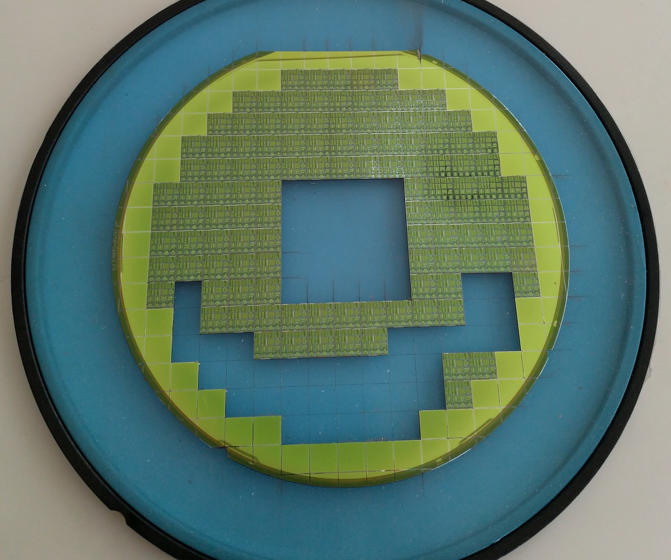
Semiconductor wafer on dicing tape (representative image), Wikimedia Commons, CC BY-SA 4.0