


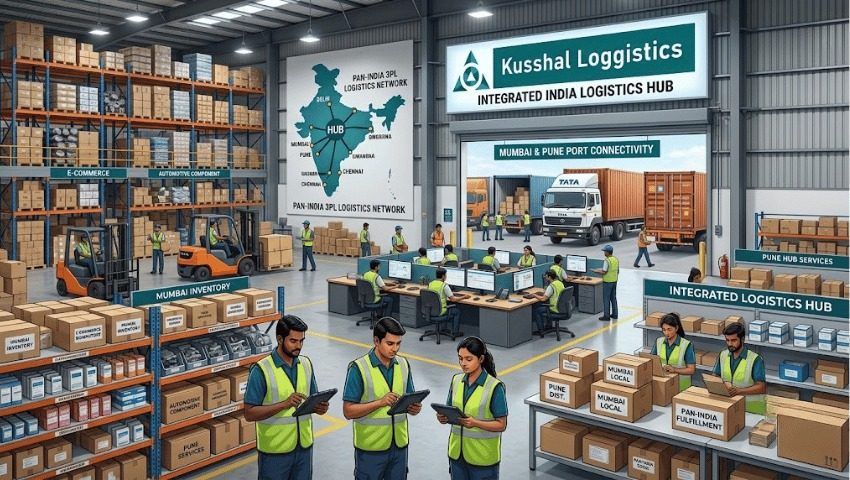
A 3PL logistics company in Mumbai manages warehousing, transportation, and distribution for businesses across the Mumbai Metropolitan Region. The right partner holds inventory near demand corridors such as Bhiwandi, Panvel, and Taloja, moves goods reliably despite city congestion, and gives you real inventory visibility. This suits manufacturers, FMCG brands, retailers, D2C sellers, and importers scaling in western India.
Mumbai does not give logistics much room. Warehouse rentals inside the city are high, land is scarce, and the storage you can actually afford usually sits an hour or more from where your customers are. Then the roads decide the rest. A dispatch that leaves late gets caught in traffic, misses a delivery window, and turns into a customer complaint by evening.
This is where businesses start looking at a 3PL logistics company in Mumbai. Not for the idea of outsourcing, but because storage cost, distance, and congestion have made in-house logistics harder to run each quarter.
This guide covers the Mumbai specifics. Where the warehouses are, how goods actually move across the region, what to check before you appoint, and when the switch makes commercial sense.
Mumbai anchors western India’s supply chain. The city combines a major port, dense consumer demand, and a manufacturing belt that extends across the wider metropolitan region.
Three factors keep it central to logistics planning:
The scale of that warehousing market is measurable. A CREDAI and CRE Matrix report, cited by IBEF (October 2024), noted that the Mumbai Metropolitan Region, Pune, and NCR together accounted for around 64% of Grade A warehousing demand in the first half of 2024. Grade A here means modern, higher specification facilities built for efficient handling rather than basic storage.
The key distinction is this. Mumbai gives you demand and infrastructure in one place. It does not give you cheap or convenient space, which is exactly why location strategy matters more here than in most cities.
3PL is not a single service. It is a set of functions that work together, and Mumbai operators typically cover all of them.
Storage forms the base of most arrangements in the region. It usually takes one of two forms:
Dedicated space suits high, stable volumes. Shared space suits businesses that want to control cost and scale up or down as demand shifts, which matters in a market where rentals are high.
Movement is the second core function. In and around Mumbai it splits into two categories:
Primary transportation, moving goods from the port or plant to the warehouse, often runs alongside these.
Distribution connects storage to the market. This covers warehouse to distributor movement for B2B networks and last leg delivery for B2C and ecommerce orders across the metropolitan region.
Location decides most of your logistics cost in Mumbai. The city core rarely holds affordable large format storage, so 3PL warehousing clusters along specific corridors outside it.
Four locations account for much of the region’s organised warehousing.
The right corridor depends on where your goods come from and where they go. A business serving Mumbai retail has different needs from an importer moving containers off the port. This does not mean one corridor is better than another. It means the appropriate choice follows your inbound source and your delivery geography, not a general reputation.
Transport is where Mumbai logistics succeeds or fails. Distance and congestion make timing harder here than in most Indian cities, and a poorly planned route erases the savings of cheaper storage.
Plan for the following realities:
The practical response is planning, not hope. A capable operator schedules dispatches around known congestion, sequences deliveries by zone, and holds visibility on where each shipment sits. Without that discipline, the cheaper warehouse simply moves the cost into failed delivery windows.
Choose on fit, not on size. The largest operator in the region is not automatically the right one for your product and geography.
Assess each provider against practical markers:
References reveal more than presentations. A short call with a current client tells you how a provider performs during a congested dispatch day, which no proposal can show.
Ask specific questions. Vague questions produce vague answers, and the gaps surface later, usually during a peak season.
Useful questions include:
That last question separates a provider who grows with you from one who becomes a constraint during your busiest weeks.
Some errors repeat often enough to be predictable. Avoiding them saves both cost and disruption.
The pattern is consistent. Most Mumbai 3PL regrets trace back to location and planning, not to the decision to outsource itself.
Outsourcing is a commercial decision, not a default. It makes sense under specific conditions.
Consider a 3PL when:
This does not mean outsourcing suits every business. A company with a well located in-house warehouse and stable volumes may gain little. The value appears when Mumbai’s cost and congestion outpace your capacity to manage logistics internally.
Kusshal Loggistics operates as an integrated third party logistics provider serving businesses across India, including the Mumbai region. The relevance is direct: it brings warehousing, transportation, and distribution under one operator rather than leaving you to coordinate separate vendors across scattered corridors.
The services cover the core of a full 3PL arrangement:
The commercial argument for an integrated partner in Mumbai rests on coordination. When storage and transport sit with one operator, dispatches are planned against congestion, issues are resolved faster, and you communicate through a single point rather than chasing several vendors across Bhiwandi, Panvel, and the city. For manufacturers, FMCG brands, retailers, D2C sellers, and importers, that consolidation tends to produce more predictable operations as volumes grow.
This does not remove your oversight of logistics. It moves the daily execution off your team, so your attention stays on the parts of the business that need it.
A 3PL company in Mumbai manages outsourced warehousing, inventory, transportation, and distribution for your business. It stores goods in regional corridors, processes orders, and moves shipments across the Mumbai Metropolitan Region under one accountable operator.
Organised warehousing clusters outside the city core, mainly in Bhiwandi, Panvel, Taloja, and Thane. The right location depends on where your goods come from and where they need to reach.
Manufacturers, FMCG companies, retailers, D2C brands, ecommerce businesses, and importers benefit most. The common factor is high city storage cost or delivery timing pressure that in-house logistics can no longer manage efficiently.
Cost depends on storage volume, order profile, transport mix, delivery timelines, and corridor location. Most pricing is usage based, converting fixed logistics costs into variable costs tied to actual activity, which improves cost predictability.
Capable operators plan dispatches around known congestion windows and truck entry timing rules, sequence deliveries by zone, and track shipments in transit. This planning is what protects delivery windows despite city congestion.
Yes. Providers with corridors near Panvel and Navi Mumbai can manage container movement from Jawaharlal Nehru Port, combining port linked storage with onward transport. Confirm this capability before appointing if you import or export.
Match the provider to your inbound source, delivery geography, and volumes. Check corridor location, transport capability, port linkage, technology, and scalability before appointing. Fit with your operation matters more than provider size.
The Mumbai decision is rarely about outsourcing in principle. It is about location and planning. Define where your goods enter the region, where they need to go, and where your current setup is slipping, then evaluate providers against those specifics rather than a general pitch.
If your business is evaluating warehousing, transportation, or integrated logistics support in Mumbai, a short conversation about your shipment volumes, corridor requirements, and distribution network is usually the fastest way to identify the right operating model. The team at Kusshal Loggistics can talk through your warehousing, FTL and part load movements, and delivery needs across the MMR region, and outline what an integrated 3PL arrangement would realistically involve for your operation.