


Delhi’s air quality fell into the severe category on Monday, the day after Diwali.
The Central Pollution Control Board recorded an overall AQI of 483 at 8:10 am.
At least 15 monitoring stations were above 400.
Other city tables put Delhi at 370, so figures differ by source.
Stage III of the Graded Response Action Plan was already in force.
Delhi’s air quality worsened on Monday, November 9, 2026, the day after Diwali, with the Central Pollution Control Board recording an overall AQI of 483 at 8:10 am in the severe category, according to Organiser’s report of November 10.
At least 15 CPCB monitoring stations in Delhi were above 400, according to the same report.
Station readings reported by Organiser include Vivek Vihar at 445, Burari Crossing at 441, Jahangirpuri between 433 and 442, Rohini between 430 and 438 and DTU between 430 and 434.
Other readings in that report include North Campus at 433, Bawana at 427, Ghazipur at 418, Mundka at 417, Punjabi Bagh at 408 to 409 and Narela at 407.
Daily Jagran lists New Tehsil-Loni in Ghaziabad at 463 and Sonia Vihar in Delhi at 457, and gives Burari Crossing as 441 in one list and 449 in another, so station figures differ within and between reports.
Not every station was in the severe range: Organiser lists CRRI Mathura Road at 396, Dr Karni Singh Shooting Range at 361 and Najafgarh at 340.
The Hans India and Daily Jagran city tables, citing CPCB data for November 9, give Delhi a figure of 370, in the very poor category, which differs from the 483 overall figure.
The Hans India also reports a reading of 776 for Delhi from AQI.in at 6:51 am on Monday, which comes from a private platform and not from the CPCB.
Organiser reports that Swiss-based IQAir recorded readings above 1,000 in Shahdara and Defence Colony, without giving times or exact values, and says the difference reflects variations in methodologies.
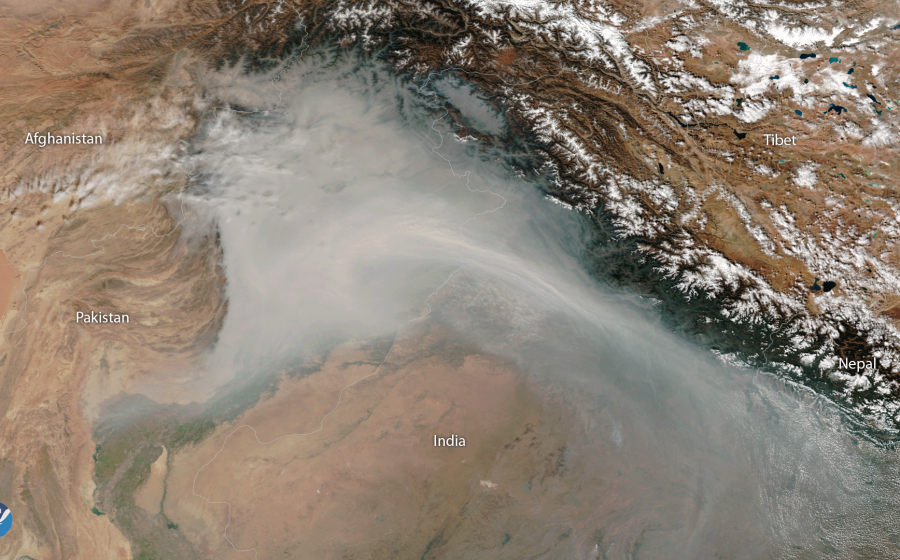
Smog over the Indus-Ganga Plain, NOAA satellite image of 2017 (file image), Wikimedia Commons, public domain