

SpaceX has delayed Starship Flight 14, the rocket’s first attempt at a full orbital mission, from September 22 to September 28, 2026.
The company did not publicly specify a reason for the six-day delay.
Super Heavy Booster 21 was rolled out to the launch pad at Starbase, Texas, on September 20-21 in preparation for the flight.
The new launch window opens at 8:15 am EDT on September 28.
Flight 14 is set to be Starship’s first true orbital mission, deploying 26 Starlink V3 satellites.
SpaceX delayed Starship Flight 14 from September 22 to September 28, 2026, without publicly specifying a reason.
The new launch window opens at 8:15 am EDT (12:15 UTC) on September 28, with a 75-minute window.
Flight 14 will use Super Heavy Booster 21 (B21) and Ship 41 (S41), both part of the newer Starship Block 3 vehicle design.
Booster 21 was rolled out to the launch pad at Starbase, Texas, on the night of September 20 into September 21 in preparation for the flight.
Booster 21 completed a 33-engine static fire test, and Ship 41 completed a 6-engine static fire test ahead of launch.
Flight 14 is intended to be Starship’s first true orbital mission; earlier flights had only flown ‘passively safe’ suborbital trajectories that avoided a full orbit.
The mission plan calls for deploying 26 Starlink V3 satellites during the flight.
Ship 41 is expected to complete six orbits of Earth before a planned splashdown in the Pacific Ocean, about 10 hours after liftoff.
Unlike some earlier flights, Super Heavy Booster 21 will not attempt a catch at the launch tower; instead it is set to perform a controlled splashdown in the Gulf of Mexico.
SpaceX said it made unspecified ‘modifications to hardware and software’ to address issues seen on the previous Starship flight.
For the first time on a Starship mission, SpaceX plans to fly two previously recovered heatshield tiles, marking an initial step toward heatshield tile reuse.
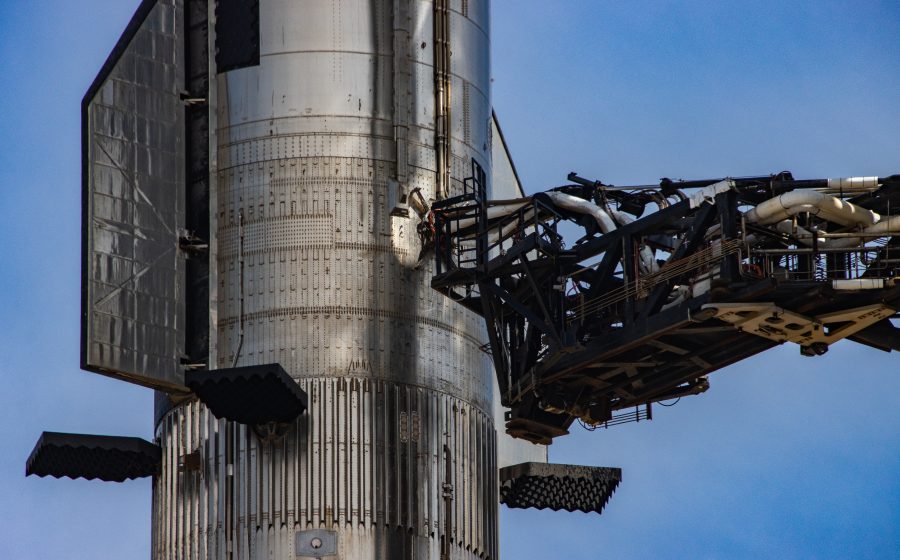
SpaceX Starship full stack, Starbase, Texas (representative image), Wikimedia Commons, CC BY-SA 4.0