


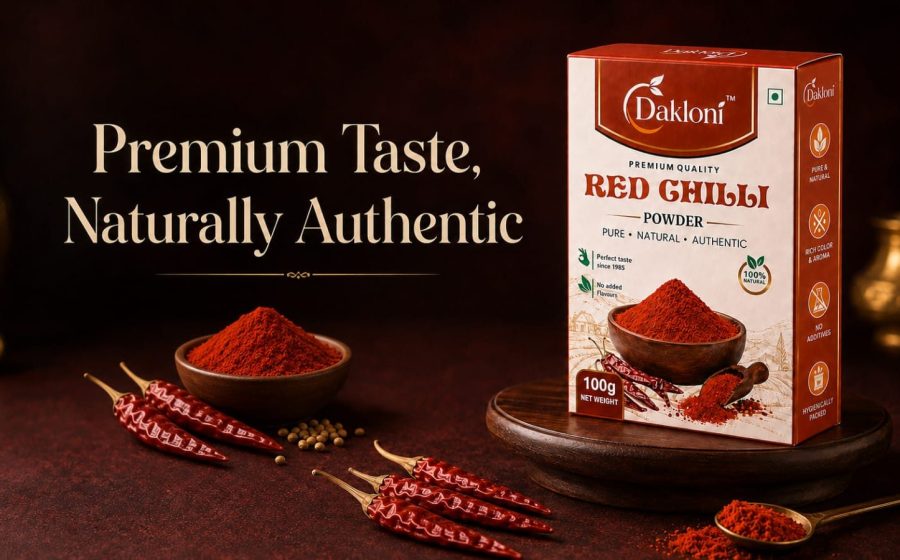
India's packaged-spice market has long been dominated by a handful of national names, but a growing tier of regional challenger brands — including the Odisha-based Dakloni Masala — has emerged over the past several years, competing on heritage narrative and purity positioning rather than shelf scale.
Dakloni Masala, operated by Green Chocy Private Limited, enters this challenger tier with a product range spanning turmeric, red and Kashmiri red chilli powder, garam masala, garlic and onion powder, dry fruits, makhana and grocery staples — a broader catalog than many single-category regional spice brands attempt at launch. Industry analysts who track India's spice sector say this kind of category breadth can help newer D2C brands increase average order value and repeat-purchase frequency, since customers buying turmeric are more likely to also add dry fruits or makhana to the same order than to seek out a second brand entirely.
Between large national spice houses and hyperlocal, unbranded loose-spice sellers sits a middle tier of regional and D2C challenger brands, most of which lean on similar language — "pure," "traditional," "hygienically packed" — making differentiation difficult without independently verifiable claims. Dakloni's positioning, built around its Odisha identity and 1983 origin story, gives it a regional hook, though the company has not disclosed how it plans to compete on price or distribution against better-funded national players.
Trade analysts who study India's food and grocery D2C sector say regional spice brands that successfully scale nationally typically combine a distinct sourcing or heritage story with consistent product quality and growing retail or marketplace presence beyond their own website — a path Dakloni has not yet publicly detailed for its own expansion.
Whether Dakloni's Odisha-rooted positioning translates into meaningful national market share remains an open question, given the company has not disclosed sales figures, distribution partnerships or growth targets publicly.
Trade analysts who track India's D2C food space say the regional challenger brands that eventually break into wider recognition typically do so by pairing a strong origin story with consistent execution — reliable delivery, responsive customer service, and steady product quality — rather than through marketing alone. For a brand like Dakloni, competing in the same middle tier as dozens of similarly positioned regional entrants, execution consistency may matter more to long-term traction than the strength of its Odisha narrative by itself.
How does Dakloni Masala compete with national spice brands?
The company positions itself around Odisha regional identity and purity-focused messaging rather than competing directly on price or retail scale with larger national brands.
What categories does Dakloni Masala sell across?
Its range spans spices (turmeric, chilli, garam masala, garlic and onion powder), dry fruits, makhana and grocery staples including cold-pressed oil and atta.
Visit- dakloni.in
Visit- dakloni.com
Facebook- Dakloni Masala
Instagram- @daklonimasala
Disclosure: This article was independently written based on information and documentation supplied by the company.