Flood Warning States in India: Latest Alert Update 2026
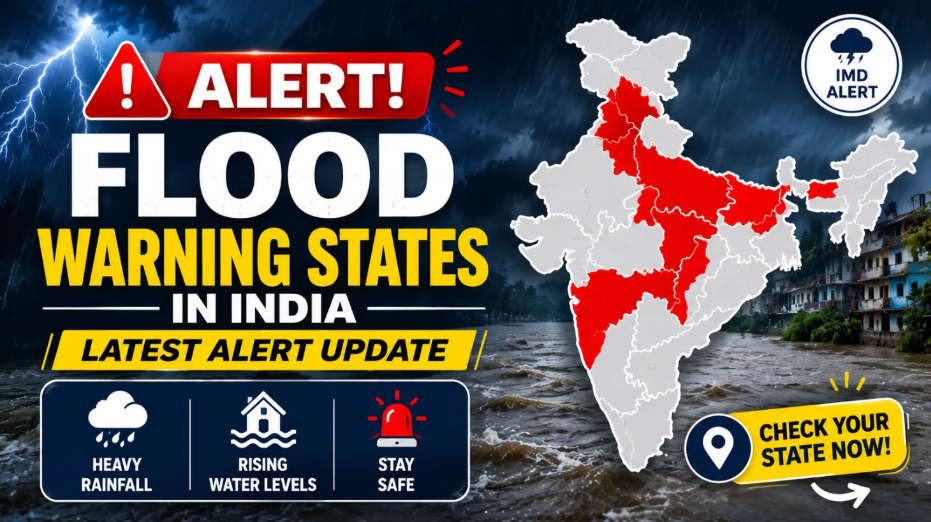
Flood Warning States in India: What You Need to Know Right Now
Monsoon season brings relief from the heat, but it also brings a very real danger — floods. Every year, thousands of families across India face sudden water logging, overflowing rivers, and damaged homes because they didn’t get warned in time. If you’re trying to figure out the current flood warning states in India, you’re in the right place. This article breaks down exactly which regions are under alert right now, how India’s flood warning system actually works, and what you should do to stay safe.
Unlike random social media rumors, everything here is based on official data from the India Meteorological Department (IMD) and the Central Water Commission (CWC) — the two government bodies responsible for tracking rainfall and river levels across the country.
Which States Are Currently Under Flood Warning? Flood Warning States
As of the first week of July 2026, weather systems have triggered flood alerts and heavy rainfall warnings across several parts of the country. According to IMD bulletins, a depression that formed over south Jharkhand and neighboring areas moved west-northwest, positioning itself over north Chhattisgarh and adjoining parts of southeast Uttar Pradesh and northeast Madhya Pradesh IMD . This system has been the main driver of heavy rain and flood risk in central India this week.
Alongside this, widespread rainfall has been forecast over Punjab, Haryana, Chandigarh, and Delhi, along with eastern Uttar Pradesh and eastern Rajasthan IMD . Coastal regions haven’t been spared either — heavy to extremely heavy rainfall has been predicted over Kerala and coastal Karnataka IMD , both classic flood warning states during peak monsoon weeks.
Meanwhile, an official IMD press release confirmed that a depression was positioned over south Jharkhand and adjoining north interior Odisha India Meteorological Department , keeping both states on close watch for flash floods and river overflow.
Why Some States Are More Vulnerable This Year .
Here’s something most people don’t realize — flood risk isn’t only about how much rain falls today. It’s also about how full the rivers and dams already are. According to the latest CWC bulletin, reservoir water storage across 13 states was below the ten-year average, including Himachal Pradesh, Punjab, Bihar, Jharkhand, Meghalaya, Mizoram, Nagaland, Odisha, West Bengal, Karnataka, Kerala, Tamil Nadu, and Telangana Down To Earth .
This creates a strange situation — some southern states are actually dealing with reservoir shortages even as flash flood alerts hit other parts of the country. Karnataka, Kerala, Tamil Nadu, and Telangana currently show reservoir levels 16 to 46 percent below normal Down To Earth , which means water managers there are walking a tightrope between drought concern and sudden flood risk from intense rain bursts.
On the eastern side, the numbers are even sharper. West Bengal’s reservoir storage is running roughly 62 percent below normal, while Mizoram sits around 54 percent below and Odisha around 19 percent below Down To Earth . When heavy, concentrated rainfall hits these already-stressed river basins, water levels can rise dangerously fast, catching residents off guard.
How India’s Official Flood Warning System Works | Flood Warning States
A lot of people don’t know that India actually has a fairly advanced flood forecasting network — most just never check it. The Central Water Commission is the nodal agency for this, and it currently operates 350 forecasting stations nationwide, with 150 stations issuing inflow forecasts for dams and barrages and another 200 monitoring river levels on major rivers Newsage .
What’s even more useful is that this isn’t just short-term guesswork. CWC has developed basin-based mathematical models that provide seven-day advance advisory forecasts, in addition to short-range alerts with response times of up to 24 hours Newsage . In simple terms — for many regions, you can actually get almost a week’s notice before a flood situation develops, if you know where to look.
For day-to-day tracking, the Central Water Commission launched the “Flood Watch India” mobile application, which provides flood forecasts for 200 stations, real-time monitoring at another 500 stations, and reservoir storage data for 150 major reservoirs Newsage . This app is genuinely one of the most underused tools available to farmers and residents in flood-prone districts.
Where to Check Live Flood Warnings
If you want to track flood warning states yourself instead of relying on WhatsApp forwards, here are the official sources:
- IMD official site – mausam.imd.gov.in (daily bulletins, rainfall warnings, cyclone alerts)
- CWC Flood Forecasting Portal – for short-range river level monitoring
- 7-Day Advisory Flood Forecast Portal – for advance basin-wise flood risk
- Flood Watch India App – for real-time station-wise flood tracking
- State Disaster Management Authority websites – for local evacuation orders and shelter information
Bookmarking even one or two of these sources can genuinely make the difference between reacting in panic and preparing in advance.
What Farmers and Families Should Do During Flood Alerts
Living in or near a flood warning state means a few simple precautions go a long way:
- Move important documents, seeds, and stored grain to higher shelves or upper floors
- Avoid crossing flooded roads or fields, even if the water looks shallow — currents can be deceptive
- Keep livestock aware of an escape route to higher ground
- Charge phones and power banks in advance, since electricity often goes down first during floods
- Follow official evacuation instructions immediately rather than waiting to “see how bad it gets”
- Farmers should avoid last-minute pesticide or fertilizer application right before expected heavy rain, since it simply washes away and wastes money
Final Thoughts
Flooding in India isn’t random — it follows patterns that scientists and government agencies track daily. The states currently facing the highest flood warning activity, based on the latest data, include Chhattisgarh, Odisha, Jharkhand, Madhya Pradesh, parts of Uttar Pradesh, Punjab, Haryana, Kerala, and coastal Karnataka. But as reservoir data shows, the situation can shift quickly, especially in regions already running below-normal water storage.
The smartest thing you can do isn’t to panic when you hear “flood warning” on the news — it’s to know exactly where to check for real, official updates before the situation escalates. A five-minute check on the IMD or CWC portal today could save your crops, your home, or even a life tomorrow.
Frequently Asked Questions (FAQs). Flood Warning States
Q1: Which government agency issues official flood warnings in India?
The Central Water Commission (CWC) is India’s nodal agency for flood forecasting, working closely with the India Meteorological Department (IMD), which supplies rainfall data and forecasts. Flood Warning States
Q2: How can I check flood warnings for my state in real time?
You can use the CWC’s Flood Forecasting Portal, the 7-Day Advisory Flood Forecast site, or the “Flood Watch India” mobile app, all of which provide live, station-wise flood data.
Q3: How much advance notice do flood warnings usually give?
Short-range alerts typically offer up to 24 hours of notice, while CWC’s advisory models can provide advance forecasts up to seven days ahead for many river basins.
Q4: Are all flood warning states facing the same level of risk?
No. Some states face immediate flash flood risk due to heavy rainfall, while others show elevated risk mainly because their reservoirs are already running below normal storage levels.
Q5: What should farmers do when a flood warning is issued for their state?
Farmers should avoid applying pesticides or fertilizers right before expected heavy rain, move stored grain to safer locations, and monitor official CWC and IMD updates closely before deciding on field activities.