


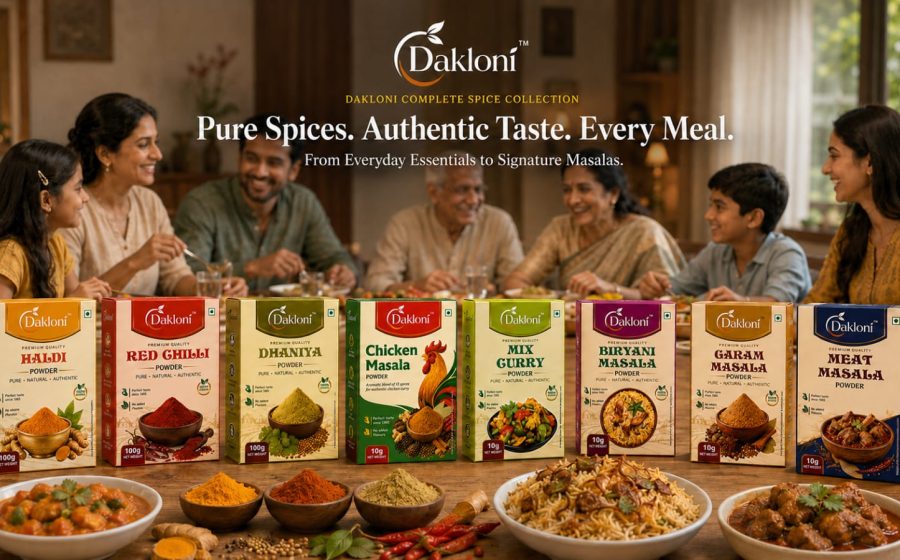
Every Indian kitchen runs on a handful of everyday spices — turmeric, chilli, a good garam masala — and it is exactly this everyday category that Dakloni Masala has built its business around. Rather than chasing exotic blends, the Odisha-based brand, active since 1983, has focused on getting the basics right: consistent grinding, careful sourcing and packaging that keeps aroma intact from the factory to the kitchen shelf. A closer look at the current Dakloni Masala catalogue shows a range designed around how Indian households actually cook, day to day.
Turmeric is arguably the most-used spice in an Indian kitchen, appearing in everything from dals and vegetable curries to marination and traditional home remedies. Dakloni Masala’s turmeric powder is marketed on the strength of its colour and earthy aroma, both considered markers of quality by home cooks who can often judge a batch of turmeric simply by its shade and smell before it even touches a pan.
The brand offers two distinct chilli powders to suit different needs. Standard red chilli powder is positioned for households that prefer a stronger, spicier kick, while Kashmiri red chilli powder is marketed for its vivid red colour and comparatively gentle heat — a combination that makes it popular for dishes where visual richness matters as much as flavour, such as tandoori-style marinades and certain curries.
Garam masala functions differently from single spices — it is a blend, typically added toward the end of cooking to layer in warmth and complexity. Dakloni Masala’s version is built around this traditional role, intended to be sprinkled into dals, curries and vegetable dishes just before they come off the heat, rounding out a dish’s flavour profile in the final minutes of cooking.
For cooks who want the flavour base of garlic and onion without the chopping, peeling or prep time, Dakloni Masala’s garlic powder and onion powder are marketed as time-saving alternatives. Both are commonly used in marinades, spice rubs, gravies and snack seasonings, offering a shortcut to flavour that fresh produce would otherwise require significant prep work to achieve.
Beyond spices, Dakloni Masala stocks a dry fruits range covering cashews, almonds, walnuts, pistachios and raisins. These are commonly used across Indian cooking and gifting — from festive sweets and everyday snacking to garnishing curries and desserts — and their inclusion rounds out Dakloni Masala’s positioning as a broader pantry brand rather than a single-category spice seller.
Across its range, Dakloni Masala repeatedly emphasises two things: organic sourcing and hygienic processing. The brand states that its spices are prepared without artificial additives and that hygiene is maintained at every stage — from raw material selection through to final packaging. In a market where spice adulteration has been a recurring concern for Indian consumers, this focus on process transparency is central to how Dakloni Masala pitches itself against both unbranded local sellers and larger packaged-spice competitors.
Dakloni Masala is the flagship spice brand under Green Chocy Pvt Ltd, which oversees the company’s sourcing, production and direct-to-consumer sales strategy. The brand sells primarily through its own website rather than depending entirely on third-party retail, giving it more control over how products are presented, priced and delivered to end customers across India.
Home cooks who stock the full Dakloni Masala range often follow a similar pattern: turmeric and chilli powders go into the base of almost every curry or dal, garam masala is reserved for the final few minutes of cooking to preserve its aroma, and garlic or onion powder gets pulled out on busy weeknights when there is no time to prep fresh aromatics. The dry fruits, meanwhile, tend to serve double duty — a handful for snacking through the week, and a larger stock kept aside for festive cooking, gifting boxes or dessert garnishing during celebrations. This everyday-plus-occasion usage pattern is part of why pantry brands like Dakloni Masala aim to keep customers ordering repeatedly rather than as a one-off purchase.
For any spice brand selling online, packaging plays a role that goes beyond presentation — it directly affects how long a product retains its aroma and potency after it reaches a customer’s kitchen. Dakloni Masala positions its packaging as part of its broader hygiene and quality commitment, intended to protect spices from moisture and exposure during transit so that what arrives at a customer’s door matches what left the processing facility, rather than a product that has already begun losing its character in transport.
Customers can explore the full Dakloni Masala range and place orders directly through the brand’s official websites:
The brand also maintains an active presence on social media:
Taken together, the Dakloni Masala catalogue reflects a straightforward strategy: cover the spices Indian households reach for most often, add a dry fruits range that complements everyday cooking and festive use, and back all of it with claims of organic sourcing and strict hygiene — all sold directly to the customer’s door through the brand’s own D2C channels.